
-
Consulting ▼
Consulting Services
-
Solutions ▼
Marketing AI
Support AI
Analytics AI
- Technology
- About
Helps you build detailed hiring requirements — hard skills, soft skills, acceptable levels for each. Creates the foundation for objective candidate evaluation.
Book AI AuditPretty much every company hiring for a role starts the same way.
Hiring manager writes a job description. Lists some requirements: "Must know Python." "Good communication skills." "Team player." Generic stuff that could describe a thousand candidates.
Recruiter takes this vague spec, posts the job, starts screening. But here's the problem — what does "good communication skills" actually mean? What level of Python expertise? Junior? Senior? How do you even measure "team player"?
So recruiter makes judgment calls. Different recruiters interpret requirements differently. One thinks "Python" means knows basic syntax. Another expects framework expertise. Inconsistent screening.
And then candidates get to the hiring manager interview. Manager asks random questions based on what they remember from the job description they wrote three weeks ago. No systematic evaluation. Just gut feel.
Result:
Inconsistent hiring decisions. Great candidates rejected because recruiter misunderstood requirements. Mediocre candidates advancing because they said the right buzzwords.
No objective way to compare candidates. Every hire is a gamble.
Here's the thing — this agent doesn't make hiring decisions. It helps you build a systematic framework before you even post the job.
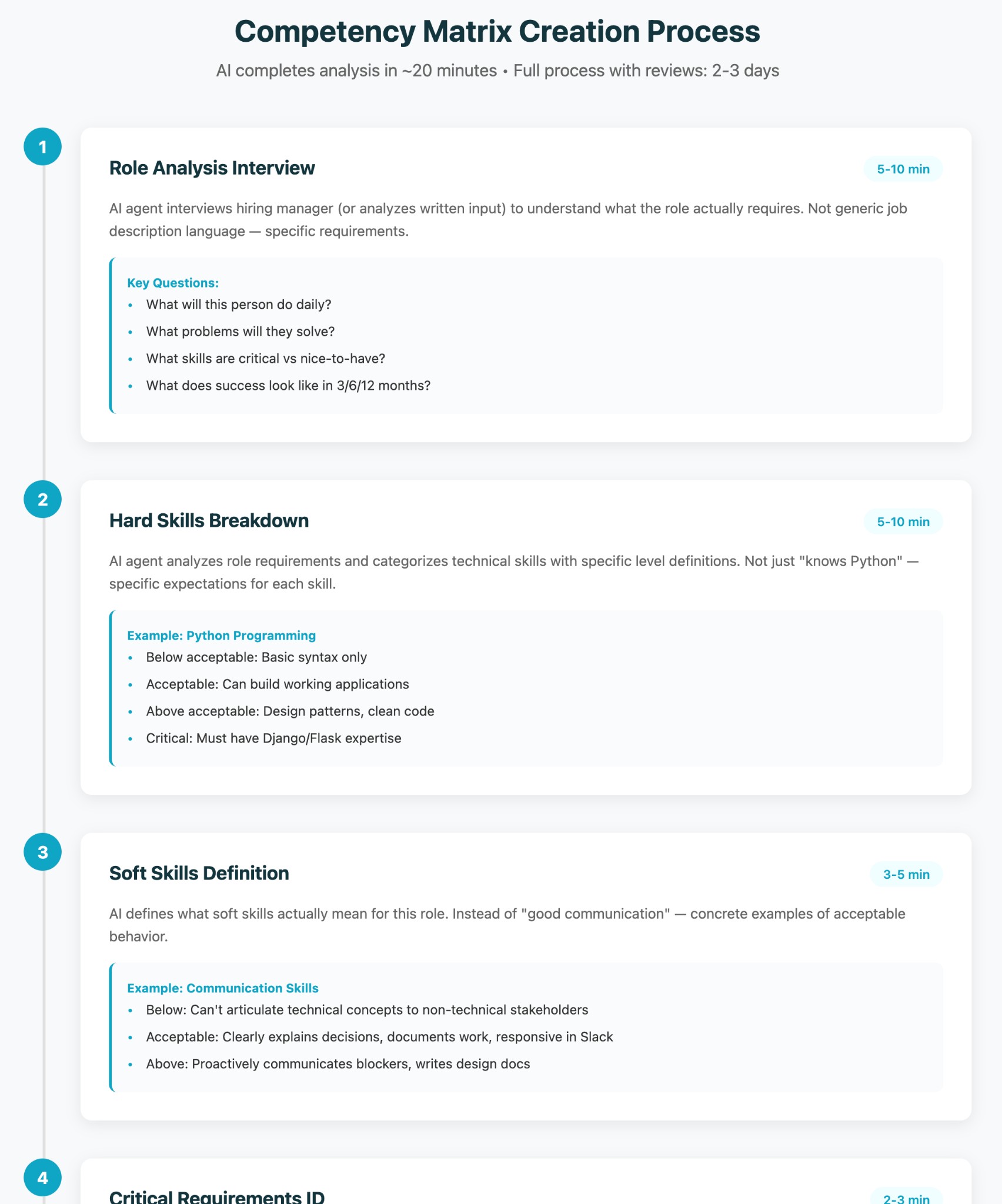
Agent interviews the hiring manager (or analyzes written input) about what the role actually requires:
Not generic job description language. Specific requirements.
Agent helps categorize technical/hard skills with specific levels:
Example for a software engineer role:
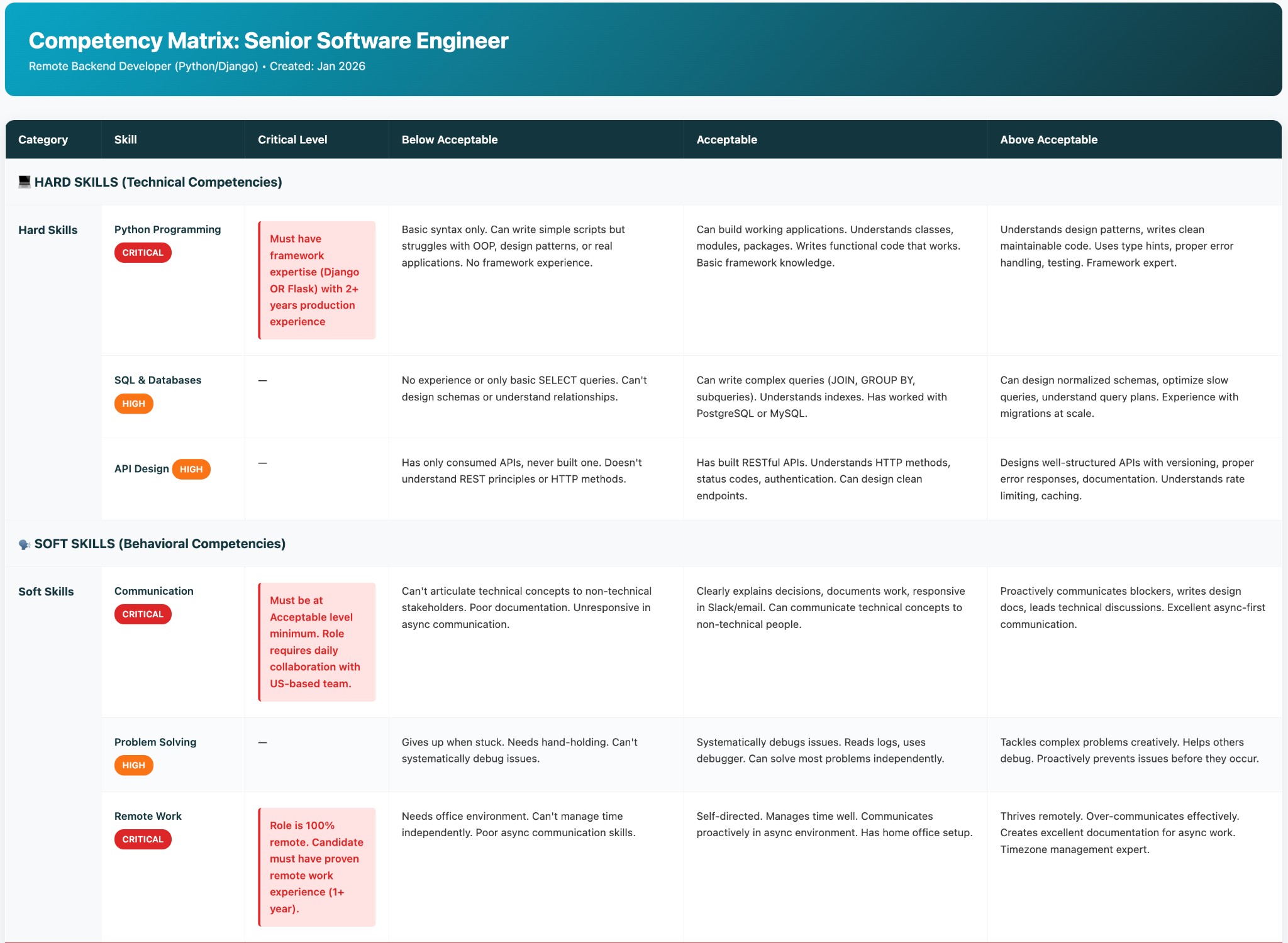
Python Programming
├─ Below acceptable: Basic syntax only
├─ Acceptable: Can build working applications
├─ Above acceptable: Understands design patterns, writes clean code
└─ Critical: Must have framework expertise (Django/Flask)

SQL/Databases
├─ Below acceptable: No experience
├─ Acceptable: Can write basic queries
├─ Above acceptable: Can design schemas, optimize queries
└─ Critical: N/A (acceptable level is fine)
Not just "knows Python." Specific expectations for each skill.
Agent helps define what soft skills actually mean for this role:
Instead of "good communication":
Communication Skills
├─ Below acceptable: Can't articulate technical concepts to non-technical stakeholders
├─ Acceptable: Clearly explains decisions, documents work, responsive in Slack
├─ Above acceptable: Proactively communicates blockers, writes design docs
└─ Critical: Must be acceptable minimum (role requires cross-team collaboration)
Now recruiters and interviewers know what they're evaluating.
Agent helps identify deal-breakers:
"If candidate doesn't have X, there's no point continuing the process."
Example:
Clear go/no-go criteria before you waste time interviewing.
Agent helps assign importance to each requirement:
What matters most? What's negotiable?
Critical (must have): Python + English proficiency
High importance: Database skills + Communication
Medium importance: Docker/DevOps experience
Low importance: Specific framework knowledge (can learn)
Now you know how to score candidates objectively.
Agent generates a structured competency matrix document:
This becomes your hiring bible for this role.
Vague job descriptions. Inconsistent screening. Interviewers asking random questions. Hiring decisions based on gut feel. No way to objectively compare candidates.
Competency matrix isn't just a document you file away. It's the input for the Interview Analysis Agent.
Once you have the matrix, you can use it to:
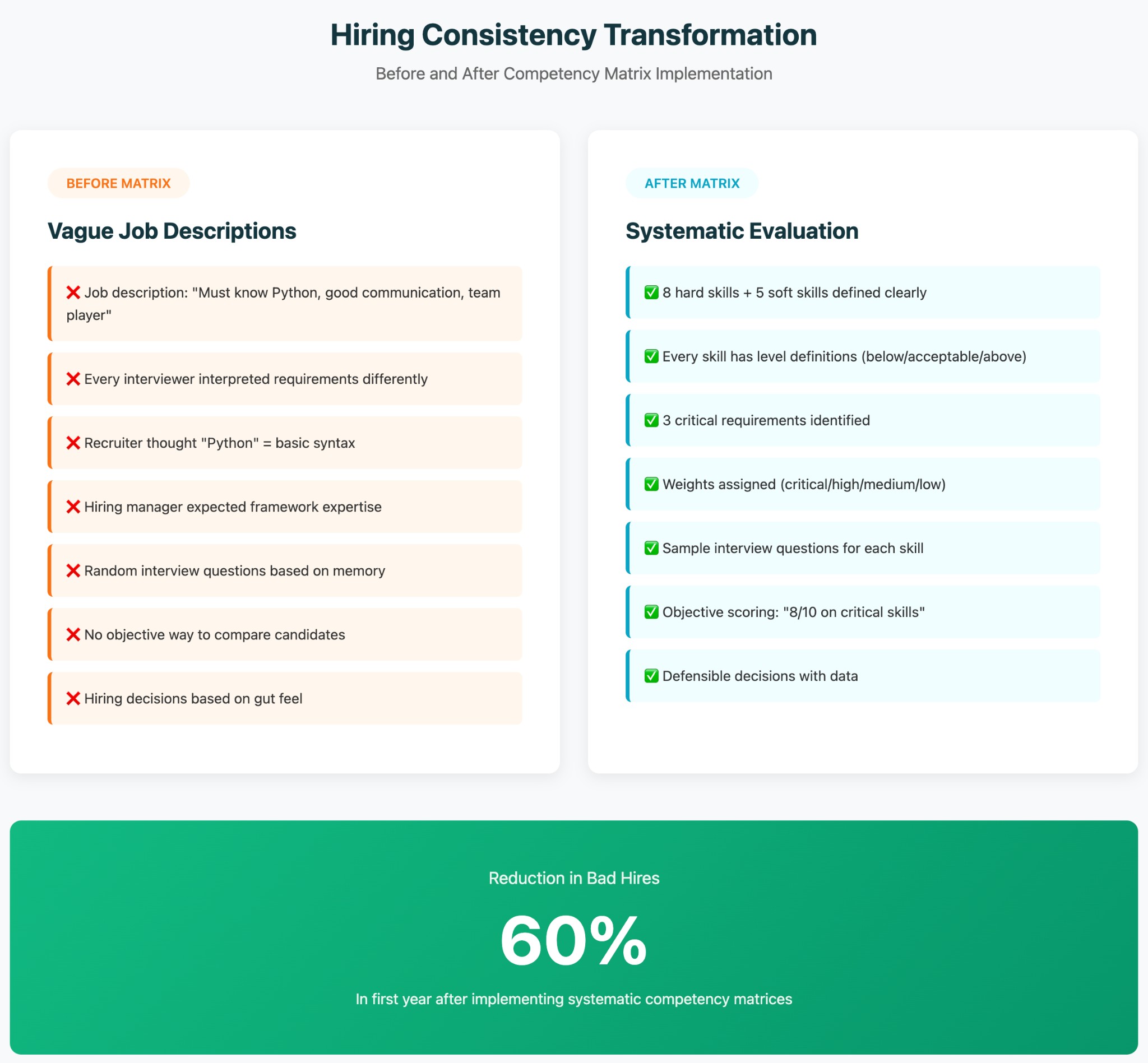
Tech company hiring software engineers. Job description said "Must know Python, good communication, team player." Generic.
Every interviewer had their own interpretation. One cared about algorithms. Another cared about system design. Third cared about cultural fit. No consistency.
We helped them build a competency matrix:
Result: Recruiters started screening more consistently. Interviewers asked relevant questions. Hiring decisions became defensible — "Candidate scored 8/10 on critical skills, 7/10 on high importance."
Not perfect. But systematic. Reduced bad hires by ~60% in first year.
For the agent to work, we need:
As long as your hiring manager can articulate what they actually need — we can build the matrix.
Look, competency matrix agent isn't magic. It's structured thinking about what you actually need from a hire.
Most companies skip this step. Jump straight to posting jobs and interviewing. Then wonder why hiring is inconsistent.
Difference: you spend 2-3 weeks upfront defining requirements clearly. Then screening and interviewing becomes systematic instead of guesswork.
Let's look at your hiring process. Maybe you already have detailed requirements for every role. Maybe you're winging it with vague job descriptions. Either way — worth a conversation.
Book $300 AI Audit
Want to see what's possible first?
Get our Free Guide