
-
Consulting ▼
Consulting Services
-
Solutions ▼
Marketing AI
Support AI
Analytics AI
- Technology
- About
Tracks every email campaign metric, identifies what drives opens and conversions, surfaces insights your ESP won't show you. Deep pattern analysis that goes beyond open rates.
Book AI AuditPretty much every email platform gives you the same dashboard.
You log into Klaviyo or Mailchimp. Look at your campaign. "24% open rate, 3.2% click rate, $8,400 revenue." Cool. Is that good? Better than last time? Why did this email work but the other one tanked?
Your ESP shows you numbers. But it doesn't tell you why. No context. No pattern recognition across campaigns. No anomaly detection when something's off.
You might manually track some stuff in a spreadsheet. Compare this month to last month. Try to remember what worked in Q3. But there's no systematic analysis. No deep dive into what actually drives performance.
Result:
You're flying blind. Making decisions based on surface-level metrics and gut feel. Missing patterns that could 2x your email revenue.
Your ESP gives you data. But data without insight is just noise.
Here's the thing — this agent doesn't replace your ESP analytics. It layers on top with AI-powered pattern recognition and anomaly detection.
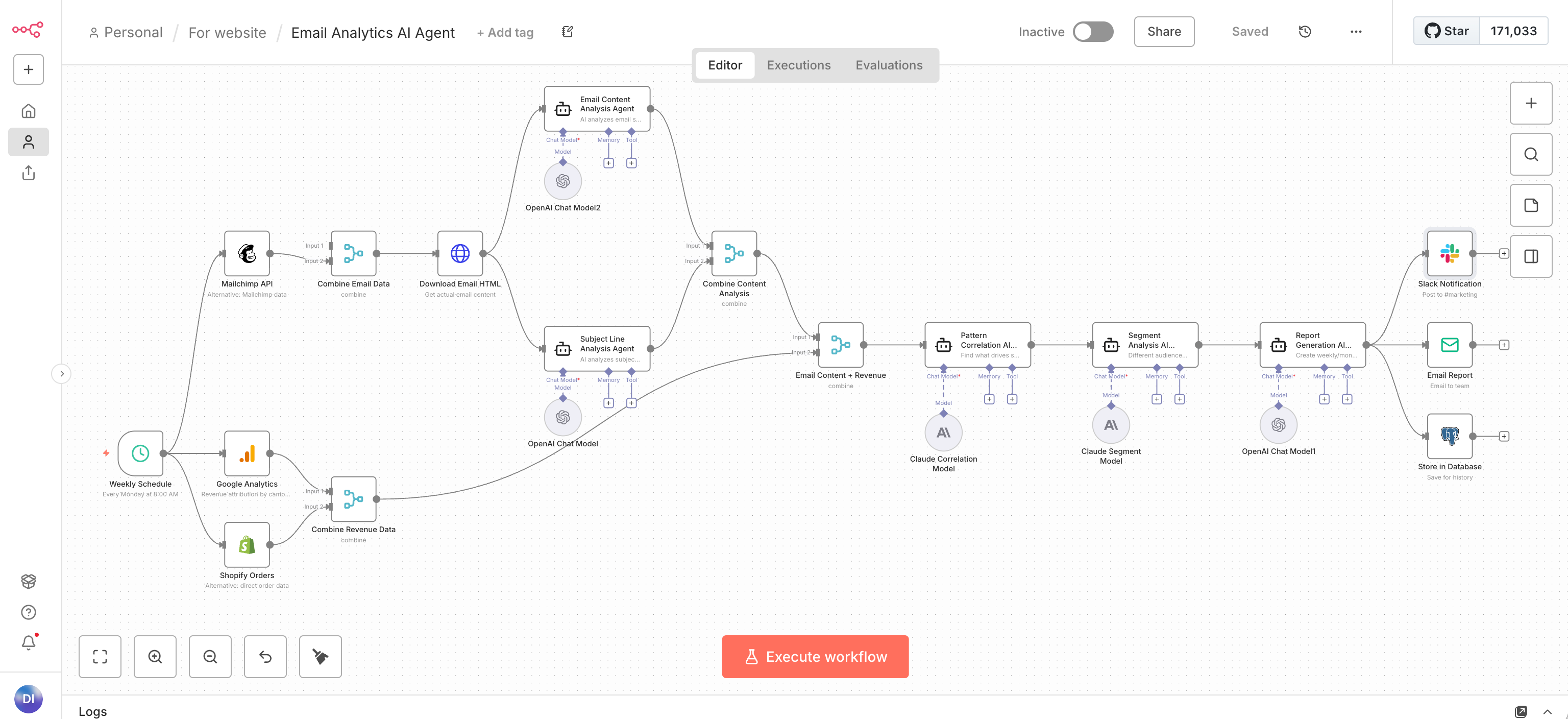
Agent pulls data from your email platform (Klaviyo, Mailchimp, etc.) and tracks everything:
Not just current campaigns — full historical analysis going back 12+ months.
This is where AI becomes useful. System identifies patterns your ESP won't show you:
Content patterns:
"Emails with customer stories drive 2.1x higher click-through than product-only emails."
Timing patterns:
"Tuesday 10am sends outperform Thursday sends by 18% for this segment."
Subject line patterns:
"Questions in subject lines drive higher opens, but lower conversions for promotional content."
Segment patterns:
"New subscribers need 3-4 educational emails before promotional content converts."
AI finds correlations humans miss when looking at hundreds of campaigns.
Agent monitors campaigns in real-time and alerts you when something's off:
Instead of discovering problems 3 days later when you check your dashboard, you get alerts within hours. Time to fix before full campaign rollout.
If you segment your list (and you should), agent shows what works for each audience:
Engaged subscribers vs. cold list.
New customers vs. repeat buyers.
High-value segment vs. general audience.
Identifies which content resonates with which people. So you stop sending the same message to everyone.
Weekly and monthly reports with actionable insights:
Reports include specific recommendations, not just "here's what happened." Tells you what to do next.
Works seamlessly with our Content Planning Agent.
Analytics agent identifies what works. Planning agent uses those insights to build next month's content calendar. Continuous optimization loop.
Check ESP dashboard once a week. Look at surface metrics. Try to remember what worked last time. Make decisions based on gut feel and recent memory.
E-commerce brand sending 3-4 emails per week. Open rates were "fine" (22-26%). But revenue was inconsistent. Some campaigns crushed it, others barely moved the needle.
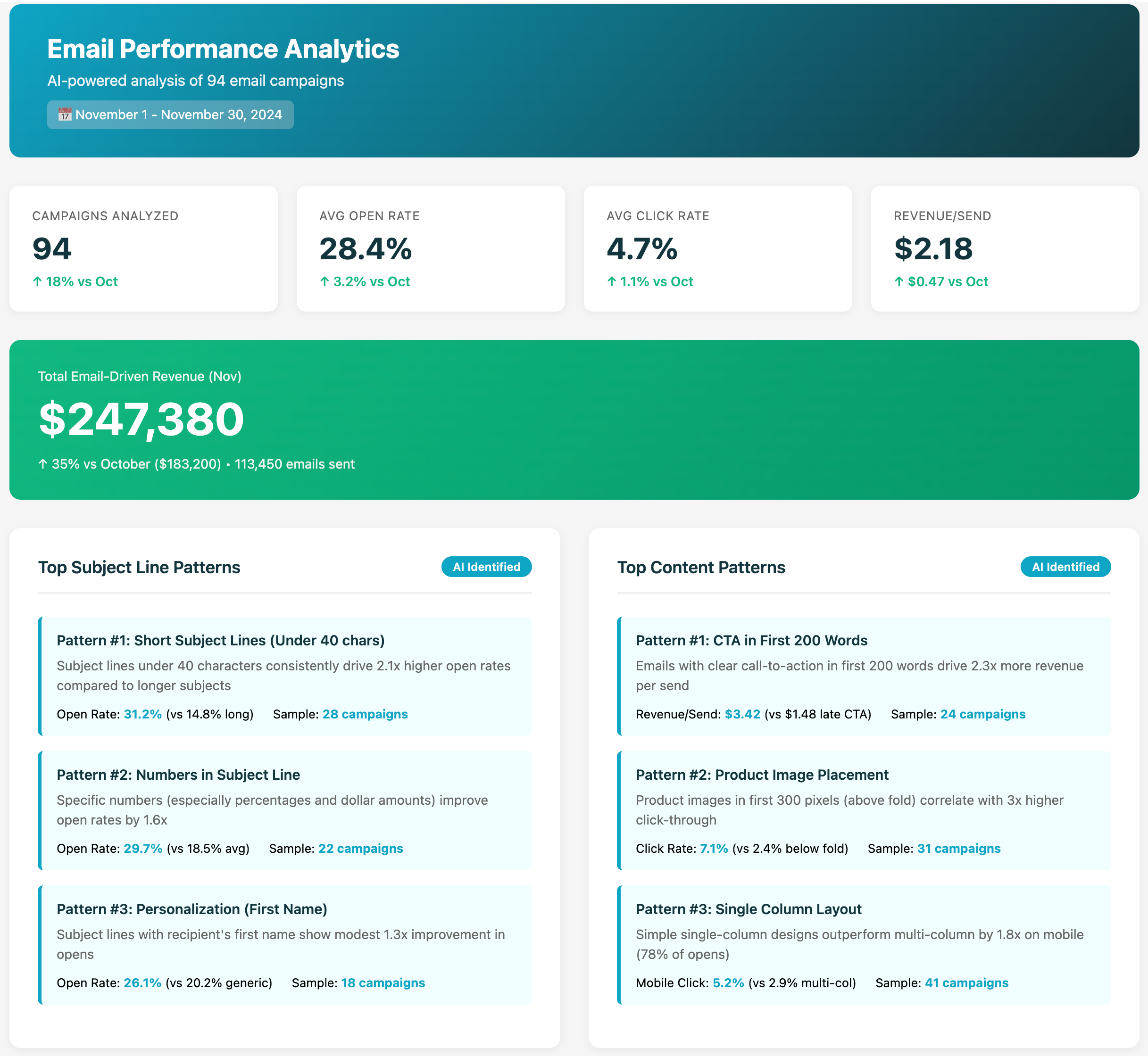
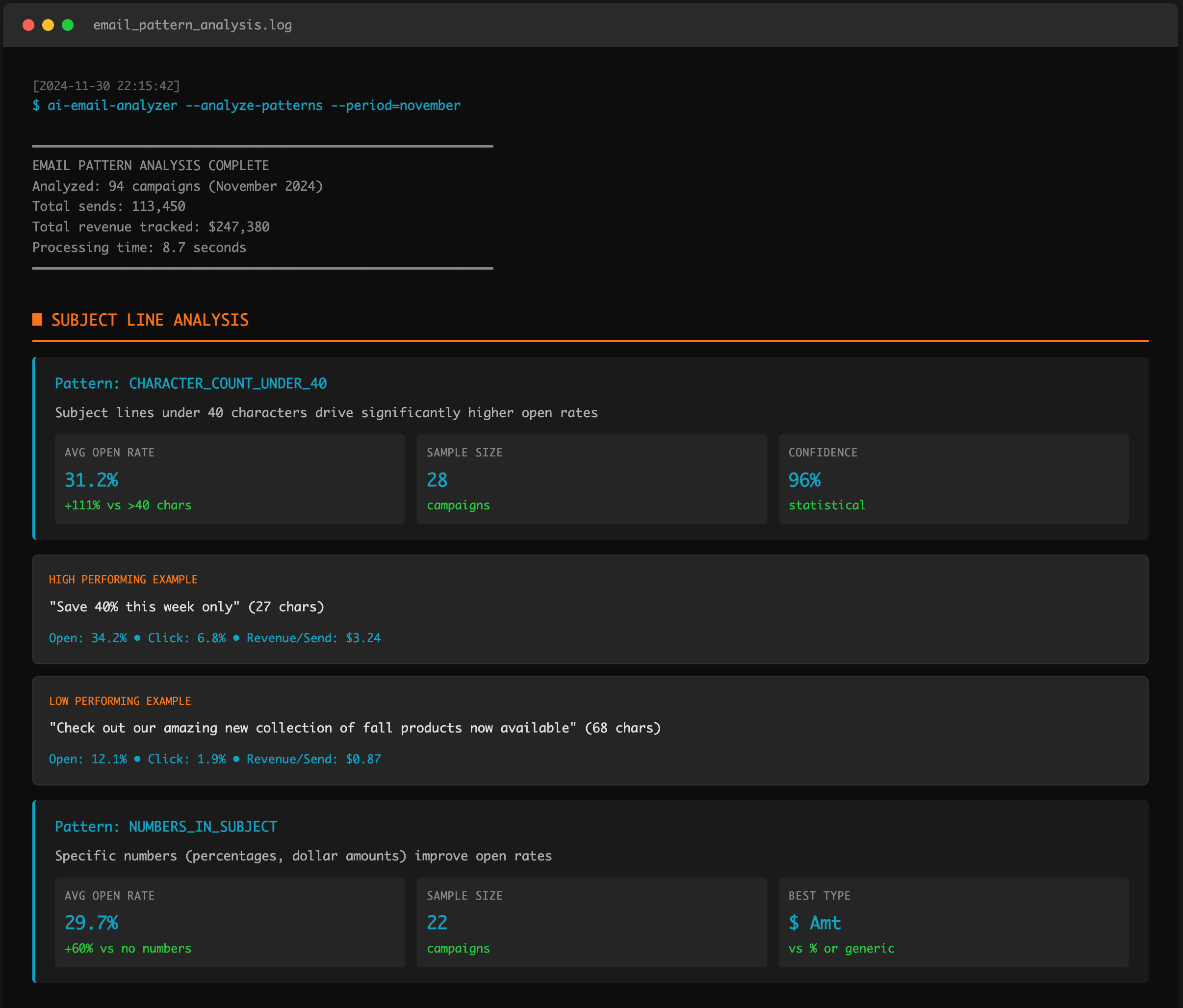
Agent analyzed 14 months of email history. Found patterns the team didn't see:
Pattern #1: Emails with specific product stories (origin, craftsmanship, materials) drove 2.3x higher revenue per send than generic product showcases. But team had only sent 8 story-driven emails in the last year because "they take longer to write."
Pattern #2: Thursday sends consistently underperformed Tuesday/Wednesday sends by 30%. But team had been rotating send days "for variety."
Pattern #3: Discount fatigue was real — more than 2 promotional emails per month saw declining conversion rates. But brand was sending 3-4 discount emails monthly.
New strategy based on data: More story-driven content. Stick to Tuesday/Wednesday sends. Limit promos to 2x per month with higher value.
Next quarter: 58% increase in email revenue with same list size and send frequency.
Same effort. Better decisions.
For the agent to work, we need:
As long as you have an email platform with API access and historical data — we can build this.
Look, email analytics agent isn't magic. It's systematic analysis of what's already in your data, surfaced as actionable insights.
Difference: instead of manually tracking spreadsheets and trying to spot patterns, AI does the heavy lifting. You get insights, recommendations, and alerts. Just make better decisions based on what the data actually says.
Let's look at your email program. Maybe you're already optimized. Maybe there are hidden patterns that could significantly increase your email revenue. Either way — worth a conversation.
Book $300 AI Audit
Want to see what's possible first?
Get our Free Guide